publications
publications by categories in reversed chronological order.
2026
- Preprint
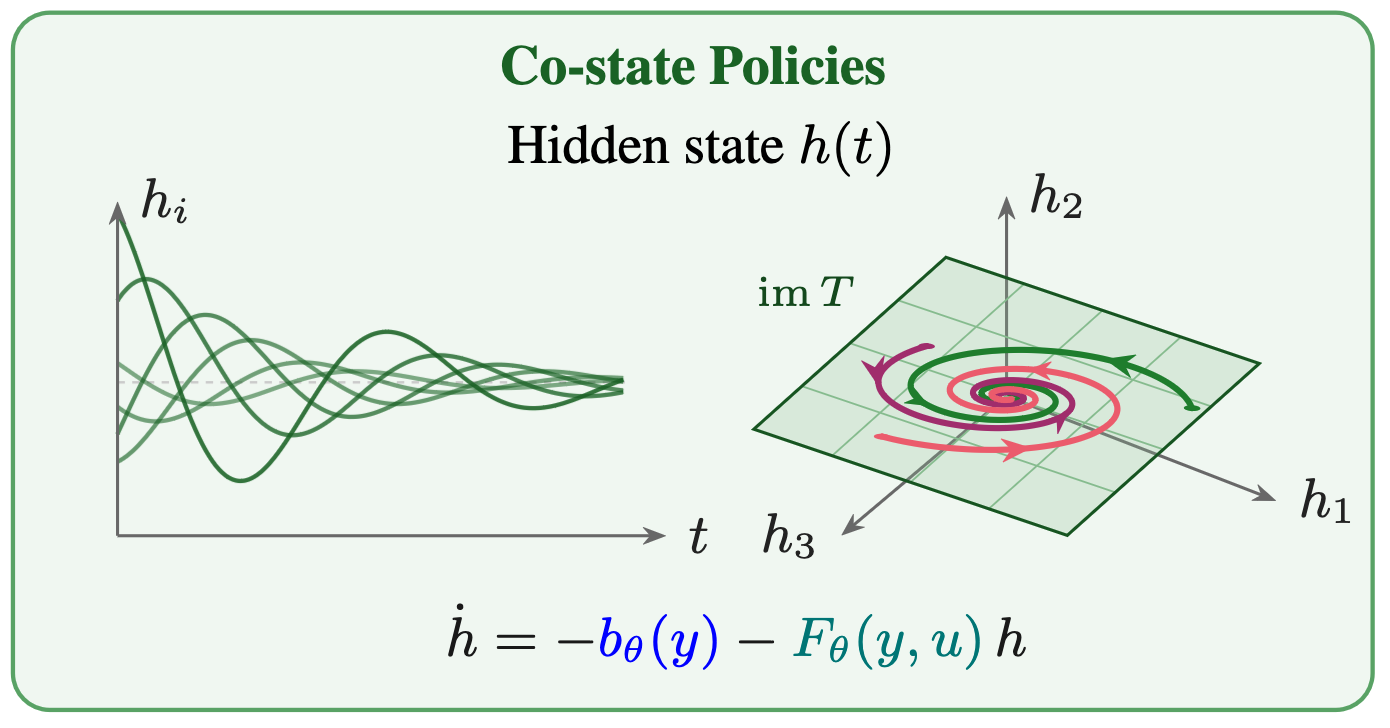 Hidden States as Value Gradients: The Pontryagin Structure of Recurrent PoliciesDavid Leeftink, Max Hinne, and Marcel GervenarXiv preprint arXiv:2605.05373, 2026
A key capability of intelligent agents is to act effectively under incomplete state observations. Recurrent policies address this by compressing observation histories into a hidden state. In this work, we show that the hidden state of a recurrent policy admits a control-theoretic interpretation: it plays the role of the co-state in Pontryagin’s minimum principle, and the readout that maps it to actions implements control-Hamiltonian minimization. The hidden state thus tracks the gradient of the value function, encoding the optimality structure of the underlying control problem. We formalize this correspondence through a class of policies we refer to as co-state policies (CPs) and show that several modern recurrent cells implicitly realize this structure. The correspondence also allows for a co-state loss for actor-critic training, in which the critic’s gradient serves as a target for the actor’s hidden state. Empirically, we find that hidden states trained with the co-state loss encode co-state information beyond what is linearly decodable from the environment state alone, and that the loss improves policies both within and outside this class on challenging locomotion tasks, including the H1 and Berkeley humanoids. By connecting the minimum principle to recurrent memory, we provide a control-theoretic account of what hidden states compute in continuous control and a mechanism for shaping them toward optimality.
@article{leeftink2026neuralcostatepolicies, title = {Hidden States as Value Gradients: The Pontryagin Structure of Recurrent Policies}, author = {Leeftink, David and Hinne, Max and van Gerven, Marcel}, year = {2026}, journal = {arXiv preprint arXiv:2605.05373}, eprint = {2605.05373}, archiveprefix = {arXiv}, primaryclass = {cs.LG}, url = {https://arxiv.org/abs/2605.05373}, } - IFAC CEP
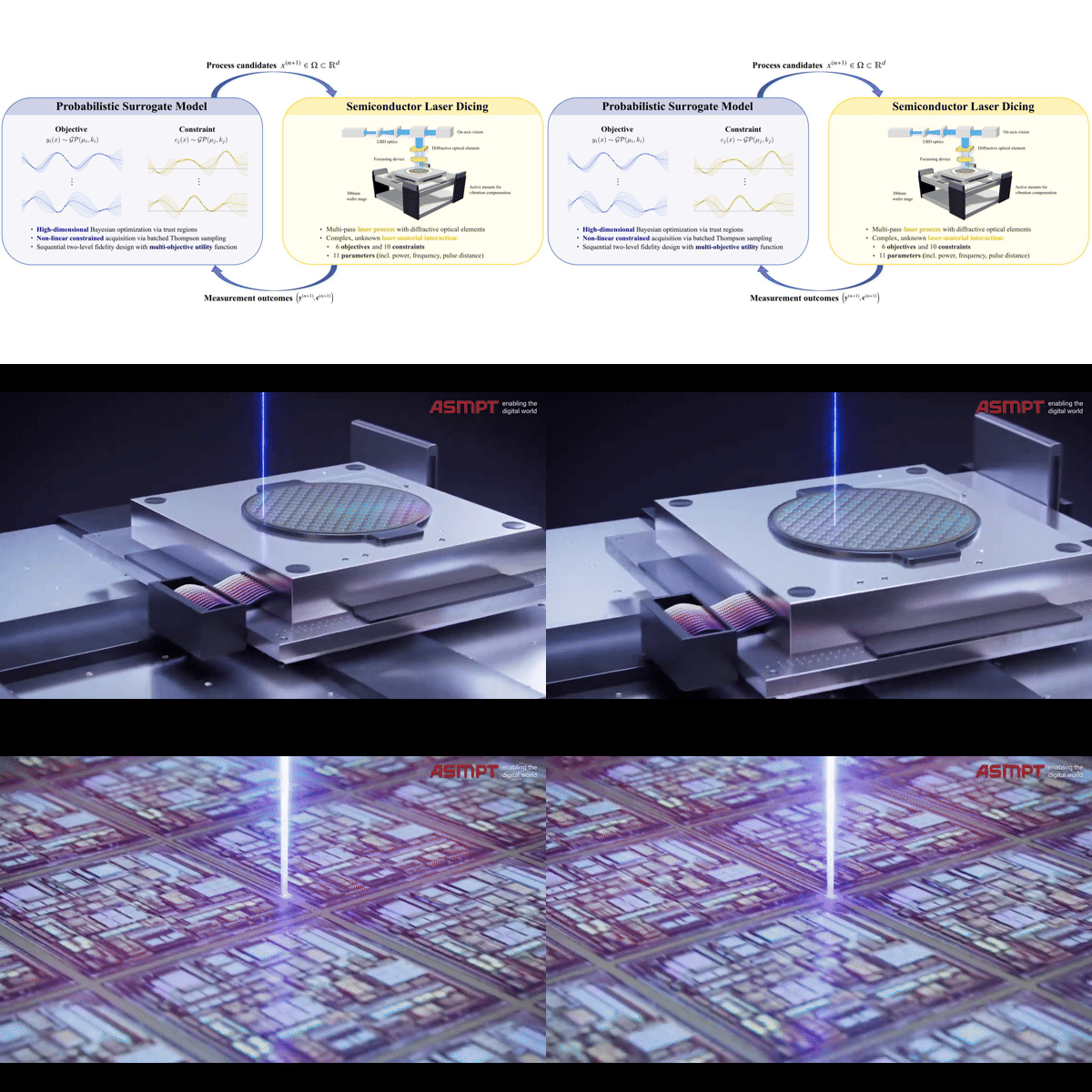 Automated discovery of laser dicing processes with Bayesian optimization for semiconductor manufacturingDavid Leeftink, Roman Doll, Heleen Visserman, Marco Post, Faysal Boughorbel, and 2 more authorsIFAC Control Engineering Practice, 2026
Laser dicing of semiconductor wafers is a critical step in microelectronic manufacturing, where multiple sequential laser passes precisely separate individual dies from the wafer. Adapting this complex sequential process to new wafer materials typically requires weeks of expert effort to balance process speed, separation quality, and material integrity. We present the first automated discovery of production-ready laser dicing processes on an industrial LASER1205 dicing system. We formulate the problem as a non-linear, constrained multi-objective Bayesian optimization task, and introduce a sequential two-level fidelity strategy to minimize expensive destructive die-strength evaluations. On bare silicon and product wafers, our method autonomously delivers feasible configurations that match or exceed expert baselines in production speed, die strength, and structural integrity, using only technician-level operation. Post-hoc validation of different weight configurations of the utility functions reveals that multiple feasible solutions with qualitatively different trade-offs can be obtained from the final surrogate model. Expert-refinement of the discovered process can further improve production speed while preserving die strength and structural integrity, surpassing purely manual or automated methods.
@article{leeftink2026laserdicing,
  title = {Automated discovery of laser dicing processes with Bayesian optimization for semiconductor manufacturing},
  journal = {IFAC Control Engineering Practice},
  volume = {172},
  pages = {106941},
  year = {2026},
  issn = {0967-0661},
  doi = {https://doi.org/10.1016/j.conengprac.2026.106941},
  author = {Leeftink, David and Doll, Roman and Visserman, Heleen and Post, Marco and Boughorbel, Faysal and Hinne, Max and {van} Gerven, Marcel},
  keywords = {Bayesian optimization, Semiconductor manufacturing, Laser dicing, Laser separation, Machine learning, Process optimization},
}
2025
- IEEE CDC
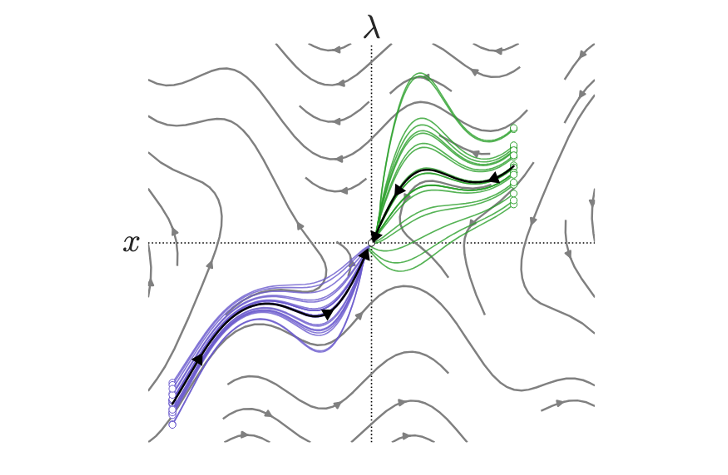 Optimal Control of Probabilistic Dynamics Models via Mean Hamiltonian MinimizationDavid Leeftink, Çağatay Yıldız, Steffen Ridderbusch, Max Hinne, and Marcel Van GervenIn 2025 IEEE 64th Conference on Decision and Control (CDC), 2025
@inproceedings{leeftink2025optimalcontrolprobabilisticdynamics, author = {Leeftink, David and Yıldız, {\c C}a{\u g}atay and Ridderbusch, Steffen and Hinne, Max and Van Gerven, Marcel}, booktitle = {2025 IEEE 64th Conference on Decision and Control (CDC)}, doi = {10.1109/CDC57313.2025.11312001}, keywords = {Uncertain systems;Uncertainty;System dynamics;Optimal control;Reinforcement learning;Ordinary differential equations;Probabilistic logic;Minimization;Mathematical models;Numerical models}, pages = {4146-4153}, title = {Optimal Control of Probabilistic Dynamics Models via Mean Hamiltonian Minimization}, year = {2025}, bdsk-url-1 = {https://doi.org/10.1109/CDC57313.2025.11312001} } - J. Neural Engineering
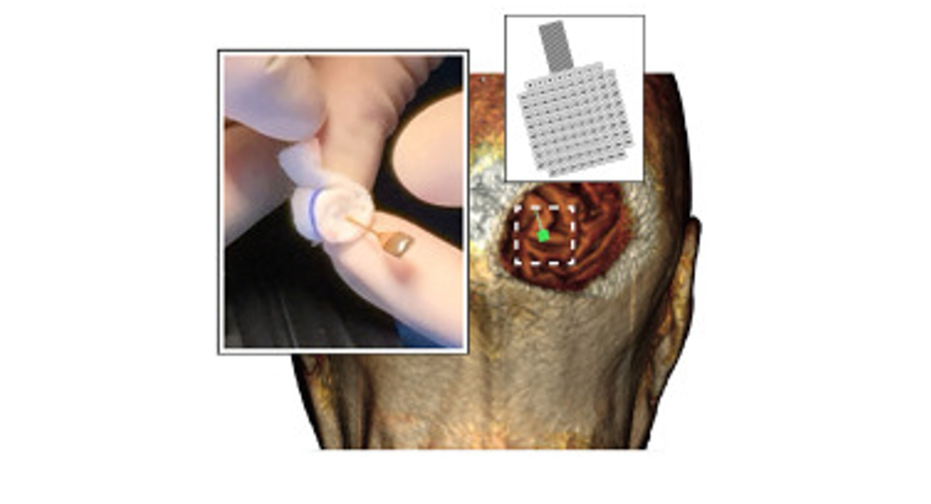 Bayesian optimization of cortical neuroprosthetic vision using perceptual feedbackBurcu Küçükoğlu, Leili Soo, David Leeftink, Fabrizio Grani, Cristina Soto Sanchez, and 3 more authorsJournal of Neural Engineering, 2025
Objective. The challenge in cortical neuroprosthetic vision is determining the optimal, safe stimulation patterns to evoke the desired light perceptions (‘phosphenes’) in blind individuals. Clinical studies gain insights into the perceptual characteristics of phosphenes through patient descriptions on provided stimulation protocols. However, the huge parameter space for multi-electrode stimulation makes it difficult to identify the optimality of the stimulation that lead to well-perceived phosphenes. A systematic search in the parameter space of the electrical stimulation is needed to achieve good perception. Bayesian optimization (BO) is a framework for finding optimal parameters efficiently. Using patient’s perceptual feedback, a model of patient response based on iteratively generated stimulation protocols can be built to maximize perception quality. Approach. A patient implanted with an intracortical 96-channel microelectrode array in their visual cortex was iteratively presented with stimulation protocols, generated via BO vs. random generation (RG) in two separate experiments. Whereas standard BO methods do not scale well to problems with over a dozen inputs, we optimize a set of 40 electrode currents using trust region-based BO. The protocols determine the electrodes to stimulate and with how much current (0–50 µA), on a total current limit of 500 µA. The patient rated each stimulation’s perceptual quality on a Likert scale, where 7 indicated the highest quality and 0 no perception. Main results. The patient ratings gradually converged on higher values with BO, compared to the RG experiment. BO gradually generated protocols with higher total current, in line with the patient preference for higher currents due to brighter phosphenes. Electrodes previously observed as effective in producing phosphene perception were chosen more by BO also with higher current allocation. Significance. This study demonstrates the power of BO in converging to optimal stimulation protocols based on patient feedback, providing an efficient search for stimulation parameters for clinical studies.
@article{kuccukouglu2025bayesian,
  author = {K{\"u}{\c{c}}{\"u}ko{\u{g}}lu, Burcu and Soo, Leili and Leeftink, David and Grani, Fabrizio and Soto Sanchez, Cristina and G{\"u}{\c{c}}l{\"u}, Umut and van Gerven, Marcel A. J. and Fernandez, Eduardo},
  doi = {10.1088/1741-2552/adeae9},
  journal = {Journal of Neural Engineering},
  number = {4},
  pages = {046024},
  publisher = {IOP Publishing},
  title = {{Bayesian} optimization of cortical neuroprosthetic vision using perceptual feedback},
  url = {https://doi.org/10.1088/1741-2552/adeae9},
  volume = {22},
  year = {2025},
  bdsk-url-1 = {https://doi.org/10.1088/1741-2552/adeae9},
}
2024
- Entropy
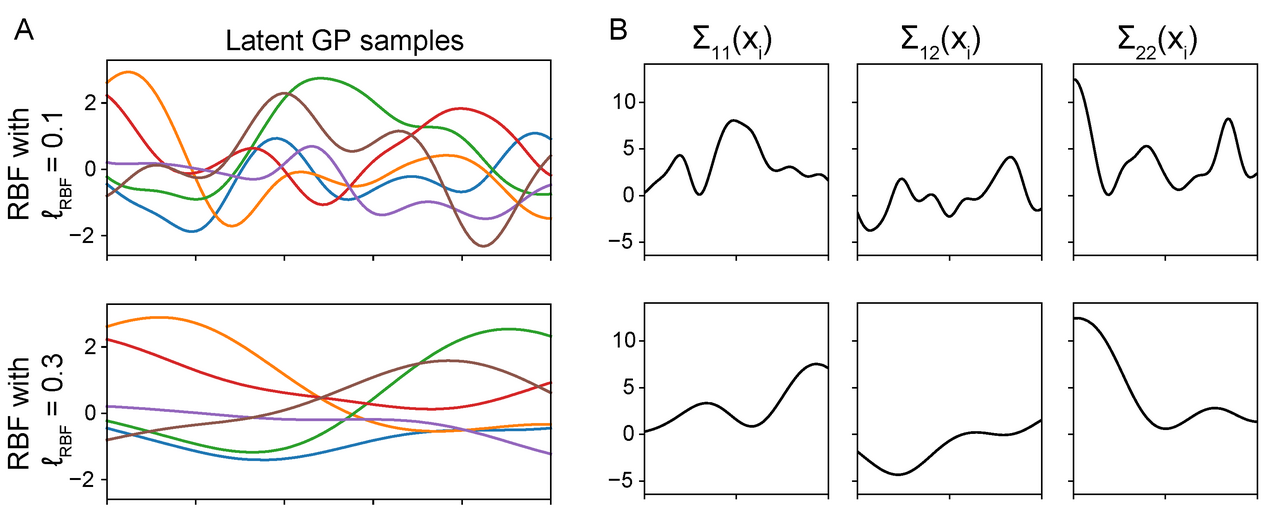 Robust inference of dynamic covariance using Wishart processes and sequential Monte CarloHester Huijsdens, David Leeftink, Linda Geerligs, and Max HinneEntropy, 2024
Several disciplines, such as econometrics, neuroscience, and computational psychology, study the dynamic interactions between variables over time. A Bayesian nonparametric model known as the Wishart process has been shown to be effective in this situation, but its inference remains highly challenging. In this work, we introduce a Sequential Monte Carlo (SMC) sampler for the Wishart process, and show how it compares to conventional inference approaches, namely MCMC and variational inference. Using simulations, we show that SMC sampling results in the most robust estimates and out-of-sample predictions of dynamic covariance. SMC especially outperforms the alternative approaches when using composite covariance functions with correlated parameters. We further demonstrate the practical applicability of our proposed approach on a dataset of clinical depression (𝑛=1), and show how using an accurate representation of the posterior distribution can be used to test for dynamics in covariance.
@article{huijsdens2024robust,
  author = {Huijsdens, Hester and Leeftink, David and Geerligs, Linda and Hinne, Max},
  doi = {10.3390/e26080695},
  journal = {Entropy},
  number = {8},
  pages = {695},
  publisher = {MDPI},
  title = {Robust inference of dynamic covariance using {Wishart} processes and sequential {Monte} {Carlo}},
  volume = {26},
  year = {2024},
  bdsk-url-1 = {https://doi.org/10.3390/e26080695},
}
2022
- PLOS ONE
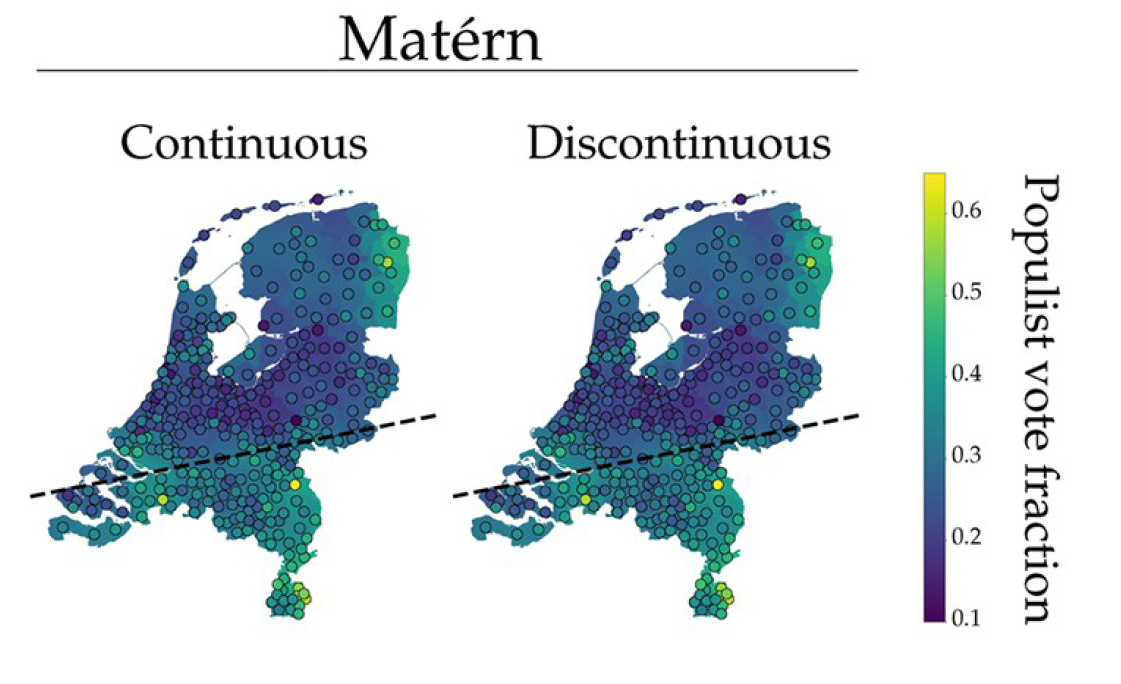 Bayesian model averaging for nonparametric discontinuity designMax Hinne, David Leeftink, Marcel A. J. Gerven, and Luca AmbrogioniPLOS ONE, 2022
Quasi-experimental research designs, such as regression discontinuity and interrupted time series, allow for causal inference in the absence of a randomized controlled trial, at the cost of additional assumptions. In this paper, we provide a framework for discontinuity-based designs using Bayesian model averaging and Gaussian process regression, which we refer to as ‘Bayesian nonparametric discontinuity design’, or BNDD for short. BNDD addresses the two major shortcomings in most implementations of such designs: overconfidence due to implicit conditioning on the alleged effect, and model misspecification due to reliance on overly simplistic regression models. With the appropriate Gaussian process covariance function, our approach can detect discontinuities of any order, and in spectral features. We demonstrate the usage of BNDD in simulations, and apply the framework to determine the effect of running for political positions on longevity, of the effect of an alleged historical phantom border in the Netherlands on Dutch voting behaviour, and of Kundalini Yoga meditation on heart rate.
@article{hinne2022bayesian,
  author = {Hinne, Max and Leeftink, David and van Gerven, Marcel A. J. and Ambrogioni, Luca},
  doi = {10.1371/journal.pone.0270310},
  journal = {PLOS ONE},
  number = {6},
  pages = {e0270310},
  publisher = {Public Library of Science San Francisco, CA USA},
  title = {{Bayesian} model averaging for nonparametric discontinuity design},
  volume = {17},
  year = {2022},
  bdsk-url-1 = {https://doi.org/10.1371/journal.pone.0270310}
}
2020
- ML4H (NeurIPS workshop)
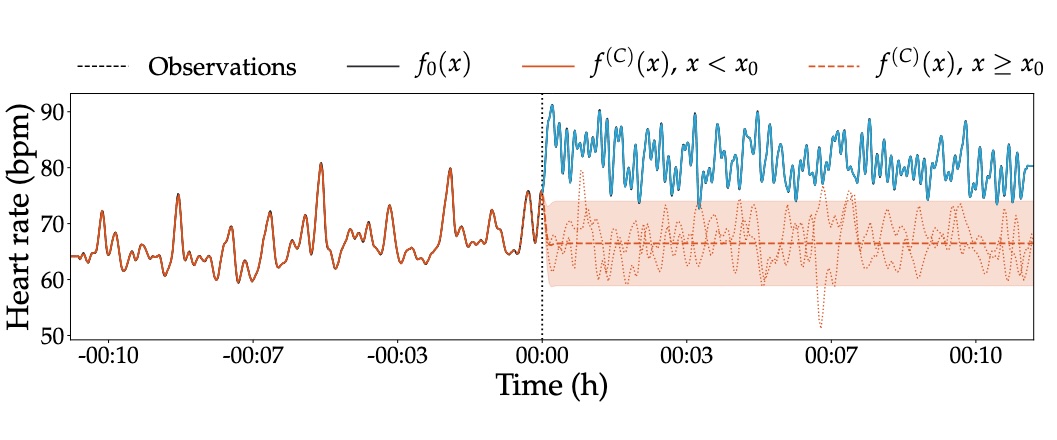 Spectral discontinuity design: Interrupted time series with spectral mixture kernelsDavid Leeftink and Max HinneIn Machine Learning for Health (workshop at NeurIPS, 2020, 2020
Quasi-experimental designs allow researchers to determine the effect of a treatment, even when randomized controlled trials are infeasible. A prominent example is interrupted time series (ITS) design, in which the effect of an intervention is determined by comparing the extrapolation of a model trained on data acquired up to moment of intervention, with the interpolation by a model trained on data up to the intervention. Typical approaches for ITS use (segmented) linear regression, and consequently ignore many of the spectral features of time series data. In this paper, we propose a Bayesian nonparametric approach to ITS, that uses Gaussian process regression and the spectral mixture kernel. This approach can capture more structure of the time series than traditional methods like linear regression or AR(I)MA models, which improves the extrapolation performance, and hence the accuracy of causal inference. We demonstrate our approach in simulations, and use it to determine the causal effect of Kundalini yoga meditation on heart rate oscillations. We show that our approach is able to detect the causal effect of interventions that alter the spectral features of these time series.
@inproceedings{leeftink2020spectral,
  author = {Leeftink, David and Hinne, Max},
  booktitle = {Machine Learning for Health (workshop at NeurIPS, 2020},
  organization = {PMLR},
  pages = {213--225},
  title = {Spectral discontinuity design: Interrupted time series with spectral mixture kernels},
  year = {2020}
}